The client has an employee rewards and gamification platform with approximately 300,000 active users. The platform can be used to create enterprise-level employee engagement programs, track employee rewards, and implement employee recognition workflows.
The infrastructure is built on AWS and includes multiple environments, including staging, QA, and production, for both legacy and modern systems. In the past, each contractor was responsible for managing their own servers, which led to potential issues with reliability, speed, and continuity.
The client needed a long-term managed services partner to support AWS infrastructure, monitor, and perform DevOps operations to stabilize operations and enhance scalability.
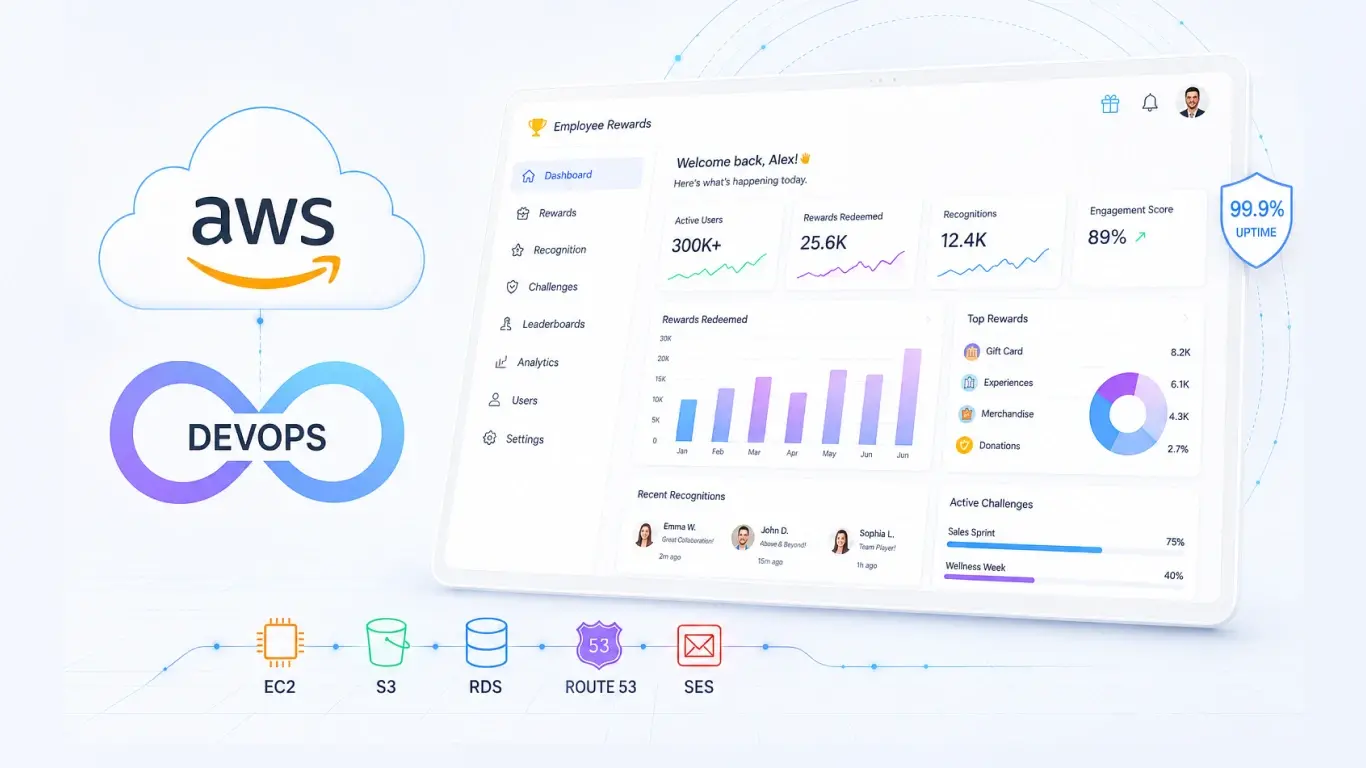
The project focused on providing continuous AWS infrastructure management and DevOps support for the employee rewards platform. It was also aimed at supporting both legacy and modern web applications. The aim is to keep the operations stable, minimize downtime threats, and offer ongoing optimization suggestions for future scalability. AllianceTek managed cloud infrastructure, monitoring services, code release support, and uptime in all environments. This is a continuous monitoring and support managed services engagement (12+ months).
01
Previously, all AWS infrastructure was managed by an individual contractor. This put the organization at a high operational risk as the availability of the individual, the transfer of knowledge, or the lack of the individual could affect system availability and business continuity.
AllianceTek launched a structured AWS managed services model, where a dedicated DevOps and support team takes care of the continuous management of the infrastructure. This removed the single point of failure and provided continuous coverage. The team developed standardised administration processes, documentation, and shared responsibility models to ensure that knowledge and access to the infrastructure were not limited to one person, which had a positive impact on continuity and reliability.
02
No formal incident response mechanism or monitoring structure was in place, so outages or performance issues may be missed or take longer to resolve. This affected the reliability of uptime and the uncertainty of system recovery times.
AllianceTek deployed continuous monitoring for all important AWS services, including EC2, S3, RDS, Route 53, SES, and SFTP systems. Real-time alerting is used to identify failures and respond to and resolve them quickly. A structured incident response workflow is also in place, ensuring that critical issues are prioritised, escalated appropriately, and addressed within agreed timelines to minimise downtime and business disruption.
03
There was no proper structure, version control discipline, or backup validation in deployment processes. This created a risk of releases, particularly when deploying to a variety of environments such as staging, QA, and production.
AllianceTek follows a structured CI/CD-based deployment workflow with Jenkins, which enables it to deploy its software in a controlled and repeatable manner. Every deployment was matched with backup validation checks to ensure rollback in the event of failure. This minimizes deployment risks, improves release stability, and guarantees consistent synchronization between legacy and modern systems in environments.
04
The infrastructure had to deal with varying workloads based on platform usage and inconsistent resource planning and support allocation. This led to inefficiencies in support needs and system performance management.
AllianceTek provides a flexible managed services engagement model based on a fixed 40-hour monthly support. This enabled the predictable allocation of resources and scalability when needed. The model provided uniform infrastructure coverage, workload distribution, and the ability to scale infrastructure support as per the system demand without over-provisioning resources.
05
Security controls were not consistently applied throughout the AWS infrastructure, which posed a risk of misconfiguration, access control, and system vulnerabilities.
AllianceTek implements AWS security best practices throughout the entire infrastructure, from access control enhancements to service-level security configurations and system hardening. Continuous monitoring was added to identify misconfigurations and possible vulnerabilities. Security compliance procedures were also incorporated into the continuous maintenance cycles for the long-term security of production systems and sensitive data.
06
The platform included both legacy CodeIgniter systems and modern Laravel + React applications, which created a challenge for infrastructure management as they had different architectures, deployment processes, and dependencies.
AllianceTek maintains a single DevOps support framework that can support legacy and modern stacks. Consistent deployment practices were used in all environments to maintain consistency. The team worked on compatibility between systems and making sure updates, monitoring, and maintenance activities did not impact either version of the system.
07
The client needed ongoing recommendations for improving infrastructure performance, decreasing operational costs, and making the infrastructure scalable for future growth.
AllianceTek provides continuous proactive monitoring and optimization recommendations according to infrastructure usage patterns. Recommendations encompassed performance tuning of AWS resources, optimizing server utilization, and optimizing deployment processes. This enabled the client to keep their AWS environment cost-effective and scalable, and to be ready for future growth.
Multi-environment AWS infrastructure (development, staging, QA, production)
The support of legacy CodeIgniter applications and modern Laravel + React applications.
Monitoring of EC2, S3, RDS, Route 53, SES, and SFTP services continuously.
Structured CI/CD deployment pipeline with Jenkins.
The process of validating and verifying the backup and recovery.
Incident monitoring and alerting system with structured response workflow.
Use SFTP to transfer files and access systems.
Managing around 30 instances and services.
Ongoing infrastructure optimization and performance tuning.
Proactive system health monitoring and reporting.
Avoiding reliance on a single contractor by providing dedicated DevOps support.
Minimized downtime with planned deployment and backup procedures.
Allowed predictable and scalable monthly support engagement.
Improved infrastructure governance and operational control.
Enhanced security posture by following AWS best practices and monitoring.
Improved system uptime with continuous monitoring and incident response.
Provided unified support for both legacy and modern application stacks.
Provided proactive performance optimization suggestions.
Maintained the smooth running of ~30 AWS instances and several services.
Ensured long-term sustainability by ongoing infrastructure enhancements.





































 Contact Us
 Previous